Taekwondo is a Korean martial art known for its emphasis on powerful and precise kicking techniques. In TAGB training, kicks are a core component, essential for grading, sparring, and demonstrations.
In Korean, kicks are called Chagi, and mastering them builds strength, balance, and agility. Taekwondo kicks serve multiple purposes, including self-defence, competitive sparring, and impressive demonstrations, making them a fundamental skill for all students.
Classification of Taekwondo Kicks
Basic Kicks (learned at beginner/intermediate levels)
Front Kick (Ap Chagi)
The front kick is one of the first kicks taught in Taekwondo and is a core foundation kick in TAGB training. It is performed by lifting the knee straight up and snapping the foot forward toward the target, usually striking with the ball of the foot.
This kick is valued for its speed, directness, and ability to create distance. It helps beginners develop balance, coordination, and basic power while learning proper leg retraction and control.
Side Kick (Yop Chagi)
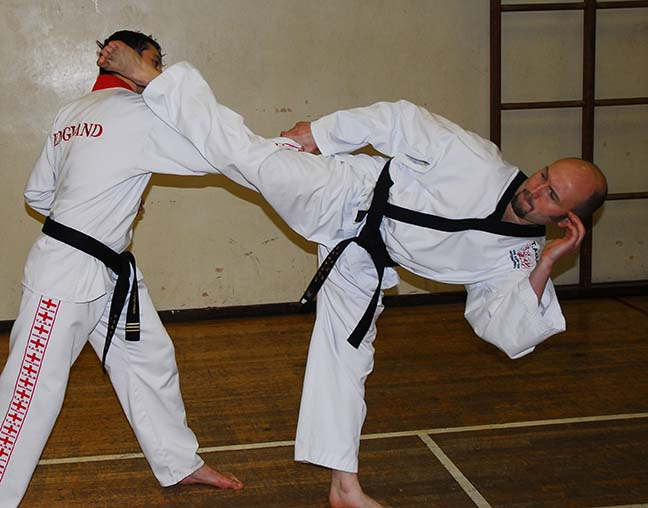
The side kick is a powerful linear kick that emphasises body alignment and hip use. To perform it, the knee is raised while the body turns sideways, then the leg is driven straight out toward the target, striking mainly with the heel.
In TAGB, this kick is taught early because it builds strong stance control and teaches students how to generate force using the hips and torso. It is effective in both sparring and self-defence due to its stopping power.
Turning Kick (Dollyo Chagi)
The turning kick is a circular kicking technique that relies on hip rotation and pivoting on the supporting foot. The kick travels in an arc and usually strikes with the instep or ball of the foot, making it ideal for targeting the body or head in sparring.
In TAGB training, this kick helps students develop timing, flexibility, and fluid movement. It is one of the most commonly used kicks in competition because of its speed and versatility.
Advanced Kicks (higher-level practice, sparring, demonstrations)
Back Kick (Dwit Chagi)
The back kick strikes behind you using the heel. The body rotates slightly, and balance is key. TAGB training uses it for counterattacks and power.
Reverse Side Kick (Bandae Yop Chagi)
A stronger version of the back kick. Turn fully, extend the leg sideways, and strike with the heel. Used in sparring and demonstrations for power and control.
Inner/Outer Crescent Kick (An Chagi / Bakat Chagi)
The crescent kick sweeps in a circular motion, inward (inner) or outward (outer). Strike with the inside or outside of the foot. Builds flexibility, balance, and creative angles in sparring.
Hook Kick (Golcho Chagi)
Extend the leg outward and sweep it back to strike with the heel. Effective for hitting the head or upper body, and keeps the opponent guessing. Requires flexibility and timing.
Reverse Turning Kick (Bandae Dollyo Chagi)
Like the hook kick but with a longer, straight-leg sweep. Heel strikes the target with added momentum. TAGB focuses on precision, balance, and power for sparring and demonstrations.
Axe Kick (Naeryo Chagi)
Raise the leg high and bring it down like an axe, striking with the heel. Targets the head or shoulders. Builds flexibility, leg strength, and control while adding a dramatic effect for demonstrations.
Demonstration and Speciality Kicks
Scissor Kick (Kawi Chagi)
The scissor kick is an advanced jump kick where both legs are used to strike two targets at once. It is mostly performed in demonstrations rather than in sparring or self-defence. This kick requires good timing, coordination, and control, making it a visually impressive move that shows a student’s skill level.
Flying Side Kick (Twimyo Yop Chagi)
The flying side kick is a dramatic kick performed while jumping into the air. The practitioner extends their leg in a side kick mid-flight, usually after taking a running start. It is effective for surprising an opponent or striking from a distance and is commonly used in demonstrations or advanced sparring.
Flying Back Kick (Twimyo Dwit Chagi)
The flying back kick is similar to the flying side kick, but focuses on striking backwards while in the air. The heel is used to hit the target, and the kick requires strong timing, balance, and body control. Like the flying side kick, it is mostly seen in demonstrations or advanced sparring situations.
Knee Kick (Moorup Chagi)
The knee kick is a close-range technique that uses the knee to hit the opponent. It is very practical in self-defence situations where kicks may not reach. In TAGB training, it helps students develop power and precision for situations where controlling an opponent at close distance is necessary.
Ready to take your Taekwondo kicks to the next level? At Evesham TAGB, our expert instructors guide students of all ages through every stage of training, from foundational kicks to advanced and speciality techniques.
Whether you’re preparing for grading, sparring, or demonstrations, our structured classes focus on strength, precision, and confidence.
Join our welcoming community today and start mastering your Taekwondo skills—book a free trial class and experience the power of proper training firsthand!
Wrapping Up
Mastering TAGB Taekwondo kicks is essential for building strength, balance, flexibility, and control, and forms the foundation for grading, sparring, and demonstrations.
Starting with basic kicks like the front, side, and roundhouse, progressing to advanced techniques such as back kicks, hook kicks, and axe kicks, and including speciality moves like flying and scissor kicks, each skill develops precision and confidence.
Consistent practice and proper technique allow students to advance safely, perform effectively in competition, and demonstrate the full power and artistry of Taekwondo.